
HOW TO ADAPT VINTAGE CANON LENSES TO A FUJIFILM GFX50Sii
The Fujifilm GFX50sii is a powerful medium format camera that offers advanced features and excellent image quality. One of the benefits of the Fujifilm GFX50sii is its compatibility with a wide range of lenses, including vintage lenses. Adapting vintage lenses to your Fujifilm GFX50sii can be a great way to add a unique touch to your photography, and can provide you with a new set of creative options. The GFX lineup all uses the G-Mount type, which can be adapted to a range of different other mounts with ease.
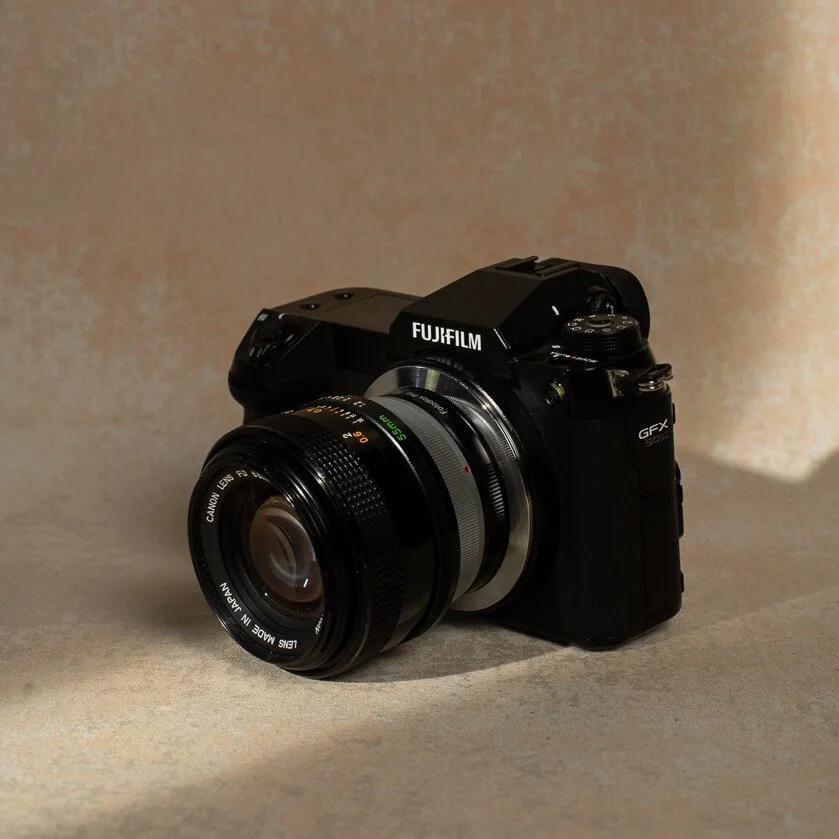
We all know that Fujifilm make some of the best lenses on the market, but what if you want to experiment with alternative looks and character? In this post I share some of my experiences of adapting Canon FD lenses to my Fujifilm GFX50sii. I have three quite different Canon FD lenses, all of which date from the 1970-80s, but offer very different experiences and outcomes.
CANON FD 55MM f1.2 SSC
My 55mm f1.2 SSC lens was the first in my line up, a small but heavy lens that produces such dreamy bokeh and almost outrageous halation, giving highlights an ethereal glow - this makes everything feel softer and gentler. I also have a 55mm 1.2 non-SSC lens which doesn’t quite live up to its younger brother - so I can only presume the Special Spectra Coating is what gives this lens its character. Because I shoot on the GFX system, the crop factor is 0.79 - meaning this 55mm lens is equivalent to 43mm on full frame. Quite an attractive, mid focal length that allows me to bring in more of the scene. One thing, however, to be wary of with this lens is the appearance of vignetting due to the lens not quite covering the sensor - so, I always shoot a bit looser and crop in post.
CANON FD 85MM f1.2 L
I love this lens so much that when I accidentally dropped it in the studio last year and broke it beyond repair I had to immediately replace it. And, despite being 40 years old, it has still held its value, so this wasn’t a cheap purchase (either the first or second time). Thankfully, my insurance covered most of the cost and I got this beauty of a lens back in contention very quickly. The 85mm focal length is equivalent to 63mm full frame, and works exceptionally well in the studio, both for close up portraits and slightly wider scenes. I don’t have an especially deep studio, so I don’t tend to use this lens to get full length shots that often, but the beautiful, sharp, delicate look of the images that I can produce from this lens means I prefer it for more intimate, up close portraits. Indeed, this has been thought of as the classic portrait lens, and you can see why.

CANON FD 135MM f2
I bought this lens recently for headshots, this telephone focal length works really well for a close up portrait - although you do have to move quite far back to get them in frame. Interestingly, I don’t reach for this lens as much as I do the 85mm in the studio, but it comes into it’s own out of the studio. I have shot a number of events recently where it worked really well to compress the scene and get close up and personal despite being on the other side of the room. Perfect for photographing speakers at a conference for example. I feel like this lens gives a neutral look, certainly not as much character as the 55mm and not as refined as the 85mm, but it still has a place in my line up.

CANON TO GFX ADAPTERS
The Canon FD to G-mount adapter from Fotodix I use works perfectly, I don’t think there’s much need to spend a fortune here. All of these lenses are manual focus, so there’s not electronics in these adapters. You can get a lot of mileage from exploring the range of lenses that one company makes, but equally, as adapters aren’t going to break the bank, you can experiment with different lenses quite easily.
EXPERIMENTATION AND TESTING
Doing your homework is one thing, but getting the lens in your hands and trying it out is really the only way to know how much you like the look of a lens for your style of shooting. What works for one photographer might not fit into your workflow or style of shooting at all. The 55mm I own has a very specific character - which I love - but it’s soft glow and excessive halation, especially wide open, means its not quite as tack sharp as the 85mm, or more modern lenses. This might matter to you, in which case, there are other options out there. But try them out and because lenses hold their value, you can easily sell them on with little to no loss.
PRICE
One great advantage of using vintage lenses is the price in comparison to newer lenses. While my 85mm is over £1000 (still quite pricey for a 40 year old lens), the 55mm and 135mm were both less than £500 each. So, amazing value for money.
High quality glass is the most effective way to use gear in order to differentiate yourself from other photographers in your niche, vintage lenses can give a character to your work that no other photographer has. Experiment with something different you’ll stand out - it’s a great investment. Check out some of my work to see the results I get with these lenses.